Showing posts with label Michael Pollan. Show all posts

Monday, September 21, 2009

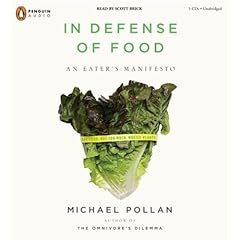
Book Review: In Defense of Food

I finished reading In Defense of Food by Michael Pollan a couple of days ago, and it was a really great, quick read. If you are reading this book *cough*Jenn*cough*, consider this your spoiler alert.


As I've posted before, Pollan's motto with In Defense of Food is "Eat food. Not too much. Mostly plants." The book itself contains a brief history of the "Western diet" (i.e. what Americans eat); commentary on how the American diet has been influenced by politics; summaries of studies related to nutrition, diet, health and farming; and recommendations on how to "eat food. Not too much. Mostly plants."

What I found fascinating about this book is how politics have played a role in the American diet. Many food producers have lobbyists, so if studies come out that show that Americans should cut back on their intake of red meat and dairy to reduce heart disease, the government can't change its dietary recommendations without getting flack from the beef and dairy producers. Therefore, the government has fueled the growth of "nutritionism," an idea that a food is as good as the sum of its nutrient parts. The government can say "cut back on saturated fat" without offending an industry group (even though it really should be saying "cut back on meat and dairy").

However, as Pollan goes to show in his book, nutritionists haven't been able to fully understand foods by breaking them down into their nutrient parts. Therefore, it's not enough to tell people to "cut back on saturated fat," or "increase your intake of fiber," as has been proven by our country's increasing problem with heart disease, obesity, cancer and diabetes. There is a synergy that exists in whole foods, so it's better to eat foods for their overall nutritional value rather than one nutritious part. For example (this is a very simplified example), scientists think carrots are good for us because they contain fiber and beta carotene. However, if you give a person fiber and beta carotene supplements, they will not receive as many health benefits as they would have if they had just eaten the carrot. (Actually, studies have shown beta carotene supplements can have harmful effects.) Therefore, it's better for nutritionists to say "eat more carrots," or "eat more leafy greens," than it is to say "eat more beta carotene," or "get more antioxidants."

Pollan also writes about studies that have shown the importance of eating whole, unprocessed foods. In places where the "Western diet" exists, a whole number of diseases have followed, including heart disease, diabetes and cancer. Where cultures eat whole foods (i.e. many of the French, Japanese, Greeks, etc.), such diseases are much more rare.

At the end of the book, Pollan gives recommendations on what to eat and how to eat it. Here are a few:
-Avoid food products containing ingredients that are unfamiliar, unpronounceable, more than five in number, or that include high-fructose corn syrup.
-Don't eat anything your great grandmother wouldn't recognize as food.
-Eat well-grown food from healthy soils.
-Do all your eating at a table.
-Pay more. Eat less.

I found it interesting how closely Pollan's findings follow the Word of Wisdom, which isn't just a list of prohibited substances for Latter-day Saints. The Word of Wisdom also includes a list of do's: eat grains, plants and a very small amount of meat; get plenty of rest. Unfortunately, many of us forget that the list of things we should do to be healthy are just as important as the things we shouldn't put into our bodies.

I enjoyed this book very much, and it has encouraged me to take better care of my body. I want to be healthy, and I want to teach my little girl how to take care of her body, too. If you're prepared to look at food differently, I highly recommend this book.

Wednesday, September 16, 2009

Food on the mind

Have you ever wondered what exactly is in that can of pop or box of cereal? I mean, what exactly is the sodium alginate and carrageenan they put in my Nutrigrain bars? I never really stopped to think about it until recently. And now that I have thought about it, Tony and I have decided to change our diet.

I've been reading "In Defense of Food" by Michael Pollan. I have to say this book falls into my "life-changing" category. I highly recommend it. The motto of the book is this: "Eat food. Not too much. Mostly plants." Pollan discusses the "Western diet" (lots of carbs, sugars, meats, dairy and processed foods), the growth of "nutritionism" (focusing on nutrients, like saturated fat, instead of actual food) and how we Americans can get healthier by eating what our grandparents ate: whole foods. What I've read so far boils down to this: The Western Diet has caused us Americans to shift from whole foods to processed foods, and we need to shift back to get healthy as a population.

And that leads me to my recent trips to the grocery store. On Monday, I was pretty much finished shopping when I began looking at the label on a container of sour cream. I noticed there were some additives on the label I didn't really recognize (according to Pollan, a sign of a processed food), and so I decided to take the short walk over to the organic foods section of the store and do some comparing. The organic sour cream had three simple ingredients, all of which I recognized and could pronounce. The only problem was the organic sour cream was $3, compared to the $.60 (with coupon) I would pay for the non-organic sour cream with additives. I decided to tour the rest of the small organic section, picking up food items and reading the ingredient labels to find that most of the organic foods contained a limited number of ingredients and very few processed additives. The frustrating thing is that organic foods can be so much more expensive!

Since we are serious about cutting processed foods from our diet and wanted to get a good idea of how much going totally organic would cost, Tony and I decided to go to our local Whole Foods store today and price out our grocery list. I bought groceries on Monday and spent $60. The same groceries (only in non- or less-processed organic form) at Whole Foods added up to $101. Unfortunately, that steep of a jump in our grocery budget isn't a possibility, so we will be making more gradual changes. We are going to try to replace processed items with home cookin'. This means I will attempt to make home-made Nutrigrain bars (I found a very promising recipe!), side dishes, etc., but our goal is to introduce one new food a week. We are also working to add more veggies to our diet and are using smaller plates to encourage portion control.

Now, please don't think that we will never again eat processed food because of this. We especially don't want people to think they have to cater to our eating habits. We are just using this blog post to share good information. These changes certainly don't mean we will never eat Doritos, cookies, canned soup or delicious Dr. Pepper again. It just means we want to eat much less of it.

I highly recommend reading "In Defense of Food" if you can get your hands on it. Be prepared to change the way you think about food, for the better. I'll post a more lengthy review after I finish the book!